










Predictive Maintenance
Predict equipment failure from sensor data to intervene before breakdowns. Machine learning offers clear returns as unplanned downtime costs are known.


Trusted by Leading Enterprises
Machine learning development is the practice of building systems that learn patterns from historical data and apply them to new cases. Rather than coding rules by hand, you provide examples of what happened before, and the model learns the relationships well enough to predict, classify or score situations it has not seen.

Approach
Answers
Best for
Reporting and BI
What happened
Understanding the past, tracking performance
Statistical analysis
Why it happened
Explaining relationships and testing hypotheses
Machine learning
What is likely to happen next
Prediction, scoring and classification at scale
Engineered for Innovation. Focused on Outcomes.
Predict equipment failure from sensor data to intervene before breakdowns. Machine learning offers clear returns as unplanned downtime costs are known.
Forecast demand at the level decisions are made, by product, location and period, accounting for seasonality and promotions rather than extrapolating last year.

Identify accounts likely to leave while there is still time to act. The value comes from what happens next, so we scope retention actions alongside the model rather than after it.

Rank prospects by conversion likelihood to focus sales efforts where they pay off. This model often offers the fastest payback.

Group customers by behaviour rather than by demography, producing segments that predict something useful instead of segments that merely describe.

Score applications and accounts for risk, with the explainability and documentation that regulated decisions require.
Price by demand, inventory, segment and elasticity, within the constraints and floors your commercial team sets.

Forecast stock requirements and optimise replenishment, balancing holding cost against the cost of running out.

Flag unusual transactions and behaviour for review, tuned to the review capacity your team actually has rather than to a theoretical threshold.
Predict equipment failure from sensor data to intervene before breakdowns. Machine learning offers clear returns as unplanned downtime costs are known.
Forecast demand at the level decisions are made, by product, location and period, accounting for seasonality and promotions rather than extrapolating last year.
Identify accounts likely to leave while there is still time to act. The value comes from what happens next, so we scope retention actions alongside the model rather than after it.
Rank prospects by conversion likelihood to focus sales efforts where they pay off. This model often offers the fastest payback.
Group customers by behaviour rather than by demography, producing segments that predict something useful instead of segments that merely describe.
Score applications and accounts for risk, with the explainability and documentation that regulated decisions require.
Price by demand, inventory, segment and elasticity, within the constraints and floors your commercial team sets.
Forecast stock requirements and optimise replenishment, balancing holding cost against the cost of running out.
Flag unusual transactions and behaviour for review, tuned to the review capacity your team actually has rather than to a theoretical threshold.

Establish which decision changes, who makes it, and what improvement would justify the work. Accuracy targets follow from this rather than leading it.

Review what data exists, how the outcome is recorded, and whether historical patterns still hold. This step frequently reshapes or ends the project, which is cheaper now than later.

Create inputs for the model, merging fields into signals that reflect actual business operations. Most performance derives from this.

Train several approaches and compare them on held out data, starting simple. A well tuned simple model often beats a complex one and is far easier to run.

Evaluate unseen data structured to reflect real deployment, with time-based splits predicting the future from the past.

Deliver predictions where the decision happens, whether that is a CRM field, a dashboard, an alert or an API. A model nobody can reach changes nothing.

Track performance and input drift in production, and retrain on a schedule or on trigger. Models decay as behaviour changes, quietly and without warning.


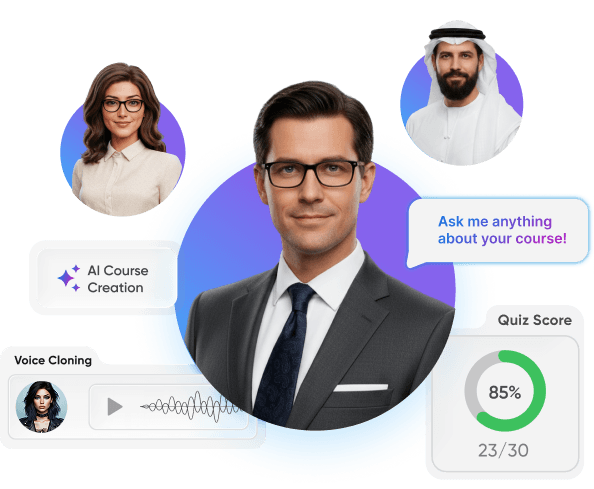
Vocaliv helps training institutes scale course delivery, reduce trainer workload, and launch new programs faster through AI-powered lesson planning, voice-based content creation, automated quizzes, and 24/7 student support.

Modern businesses lose countless opportunities simply because they cannot answer every incoming call. The AI Receptionist Platform solves this problem by providing businesses with a 24/7 intelligent voice assistant that answers calls instantly, manages bookings, and supports customers with natural conversations.

AB Ark built Angela, an AI voice assistant that answers UCLODIA’s website visitors, qualifies prospects, and books consultations in the same conversation, lifting visitor conversion from 2.4% to 8.1%.

AI4Real automates real estate marketing with intelligent video creation. It combines AI, property data analysis, and templates for agencies to create professional videos instantly.
AB Ark transformed Eventas AI into a self-operating ecosystem, replacing manual chaos with a high-precision AI Command Center.

Modern businesses often rely on multiple disconnected systems to manage tasks, communication, data, and workflows. The All-in-One Business Platform consolidates these essential tools into a single, centralized ecosystem that simplifies operations and enhances productivity across teams.

Acting CEO, Ebanah
“They work smartly.”

Director & Founder, Mahala Airtime
“This ownership mindset is rare in vendors.”

Founder & CEO, BrightWay AI
“Content creation time was reduced by 85%”

Director, SA Property Investors Network
“It's a game-changer.”

JOB SUCCESS

WORKING HOURS

HAPPY CLIENTS

PROFESSIONAL TEAM