








Enterprise Knowledge Assistant
Help authorized employees find sourced answers across policies, SOPs, wikis, research, project files and operational documentation.


Trusted by Leading Enterprises
RAG development services create AI applications that retrieve relevant information from your documents, databases and business systems before a large language model generates a response. This helps the application use current, proprietary and verifiable knowledge rather than relying only on information learned during model training.
AB Ark builds the complete RAG system. That includes data ingestion, content processing, embeddings, indexes, search and reranking, model orchestration, citations, permissions, evaluation, integrations, monitoring and user experience.

Focused question answering over one well-managed knowledge collection.
Best suited to
Focused question answering over one well-managed knowledge collection.
Key proof required
Relevant passages, supported answers and sensible fallback behavior.
Important limitation
A single retrieval step may struggle with complex or cross-source questions.
Patterns
Focused question answering over one well-managed knowledge collection.
Best suited to
Focused question answering over one well-managed knowledge collection.
Key proof required
Relevant passages, supported answers and sensible fallback behavior.
Important limitation
A single retrieval step may struggle with complex or cross-source questions.
Help authorized employees find sourced answers across policies, SOPs, wikis, research, project files and operational documentation.
Give service teams relevant product, policy and resolution guidance while preserving escalation and human approval.
Answer common questions from approved product and help content, show sources where useful, and route uncertain or sensitive cases.
Retrieve clauses, evidence, precedents, requirements or facts across contracts, reports, filings, manuals and case records.
Create briefs and source-backed answers from approved CRM context, product material, proposals, call notes and account documents.
Support role-specific questions using current training material, procedures, product knowledge and curated internal resources.

Improve natural-language discovery across catalogs, specifications, compatibility data, inventory context and customer requirements.
Add tenant-aware search, knowledge assistance, summarization and document intelligence to an existing or new software product.
Help authorized employees find sourced answers across policies, SOPs, wikis, research, project files and operational documentation.
Give service teams relevant product, policy and resolution guidance while preserving escalation and human approval.
Answer common questions from approved product and help content, show sources where useful, and route uncertain or sensitive cases.
Retrieve clauses, evidence, precedents, requirements or facts across contracts, reports, filings, manuals and case records.
Create briefs and source-backed answers from approved CRM context, product material, proposals, call notes and account documents.
Support role-specific questions using current training material, procedures, product knowledge and curated internal resources.
Improve natural-language discovery across catalogs, specifications, compatibility data, inventory context and customer requirements.
Add tenant-aware search, knowledge assistance, summarization and document intelligence to an existing or new software product.


Employees or customers need information from internal policies, product documentation, contracts, tickets, research or operational systems.
The system must reflect updated content without retraining the model whenever a document, record or policy changes.
Important answers should link back to the passages, documents or records that support them.

Compare providers, model classes, retrieval patterns, hosting approaches, integrations and build-versus-buy choices

Relevant information exists across multiple structured and unstructured sources and is difficult to find through one interface.

The use case requires domain context, business terminology, customer-specific data or approved operating guidance.

Retrieval misses useful content, citations are weak, permissions are unreliable, latency is high or quality cannot be measured.

Carry user, role, tenant, document and record-level access rules into retrieval rather than treating the index as one open knowledge pool.

Index only the information the use case needs and apply handling rules for confidential, personal, regulated or restricted content.

Authenticate connectors, validate files, detect unsupported content and remove indexed data when its source is deleted or access changes.

Test indirect prompt injection, malicious documents, unsafe links and instructions embedded inside source material.

Apply source constraints, relevance thresholds, abstention, structured outputs, validation and human review according to the impact of an error.

Design identity, storage, indexes, caches, logs and application services to prevent cross-boundary exposure.
Users, questions, sources, permissions, risks, baseline, success measures, scope and acceptance criteria.
Source inventory, ownership, access, freshness, parsing, chunking, metadata, indexing and synchronization approach.
The agreed assistant, search experience, copilot, workflow or product feature with user and administrator interfaces.
Embeddings, lexical/vector/graph search, filters, reranking, context assembly, citations and fallback behavior.
Representative queries, expected evidence, rubrics, metrics, results, failure analysis and release thresholds.
Connectors, APIs, identity integration, environments, configuration, infrastructure guidance and release documentation.
Data boundaries, permissions, tenant isolation, guardrails, logging, incident handling and change controls.
Agreed code, setup instructions, architecture notes, runbooks and knowledge transfer, with ownership defined in the engagement terms.
Prioritized improvements for source coverage, retrieval, answer quality, latency, cost, adoption and advanced RAG capabilities.

We treat source coverage and retrieval quality as primary engineering problems rather than trying to prompt around weak context.

Our scope can cover data pipelines, search, model orchestration, product experience, integrations, cloud infrastructure and operations.

We define representative questions and measurable acceptance criteria before recommending broader deployment.

We design retrieval around identity, source access, tenant boundaries, auditability and the consequences of information exposure.

We compare suitable commercial, cloud-managed and open options against quality, privacy, latency, scale, cost and maintainability.

We can begin with discovery, improve an existing prototype, build a focused POC or deliver and support a complete production application.
AB Ark can work with suitable commercial APIs, cloud AI platforms and open-weight models. The recommendation should follow the use case rather than a preferred logo or a model leaderboard.


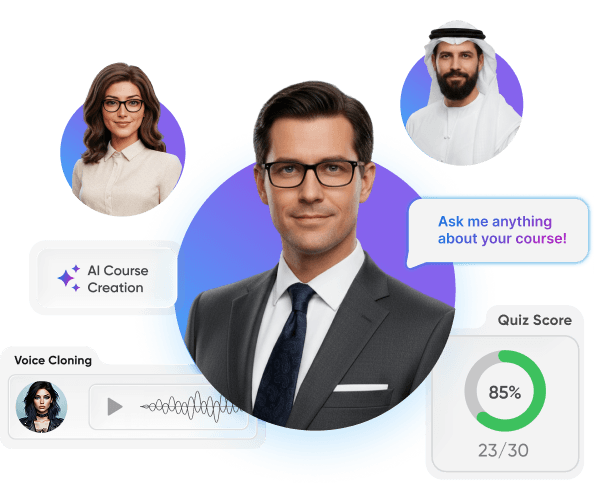
Vocaliv helps training institutes scale course delivery, reduce trainer workload, and launch new programs faster through AI-powered lesson planning, voice-based content creation, automated quizzes, and 24/7 student support.

Modern businesses lose countless opportunities simply because they cannot answer every incoming call. The AI Receptionist Platform solves this problem by providing businesses with a 24/7 intelligent voice assistant that answers calls instantly, manages bookings, and supports customers with natural conversations.

AI4Real automates real estate marketing with intelligent video creation. It combines AI, property data analysis, and templates for agencies to create professional videos instantly.

AB Ark transformed Eventas AI into a self-operating ecosystem, replacing manual chaos with a high-precision AI Command Center.

Modern businesses often rely on multiple disconnected systems to manage tasks, communication, data, and workflows. The All-in-One Business Platform consolidates these essential tools into a single, centralized ecosystem that simplifies operations and enhances productivity across teams.

QS Learning and Ab Ark built a Smart Online Academy, turning a traditional tutoring center into a seamless digital platform. With automated scheduling, an integrated classroom, and an SEO-optimized website, parents and students can easily find, book, and attend classes anytime.

CL Manager at Ebana

CEO at VYB Digital

CEO at Brightway

Director at SA Property Investors Network
CL Manager at Ebana
CEO at VYB Digital
CEO at Brightway
Director at SA Property Investors Network

JOB SUCCESS

WORKING HOURS

HAPPY CLIENTS

PROFESSIONAL TEAM